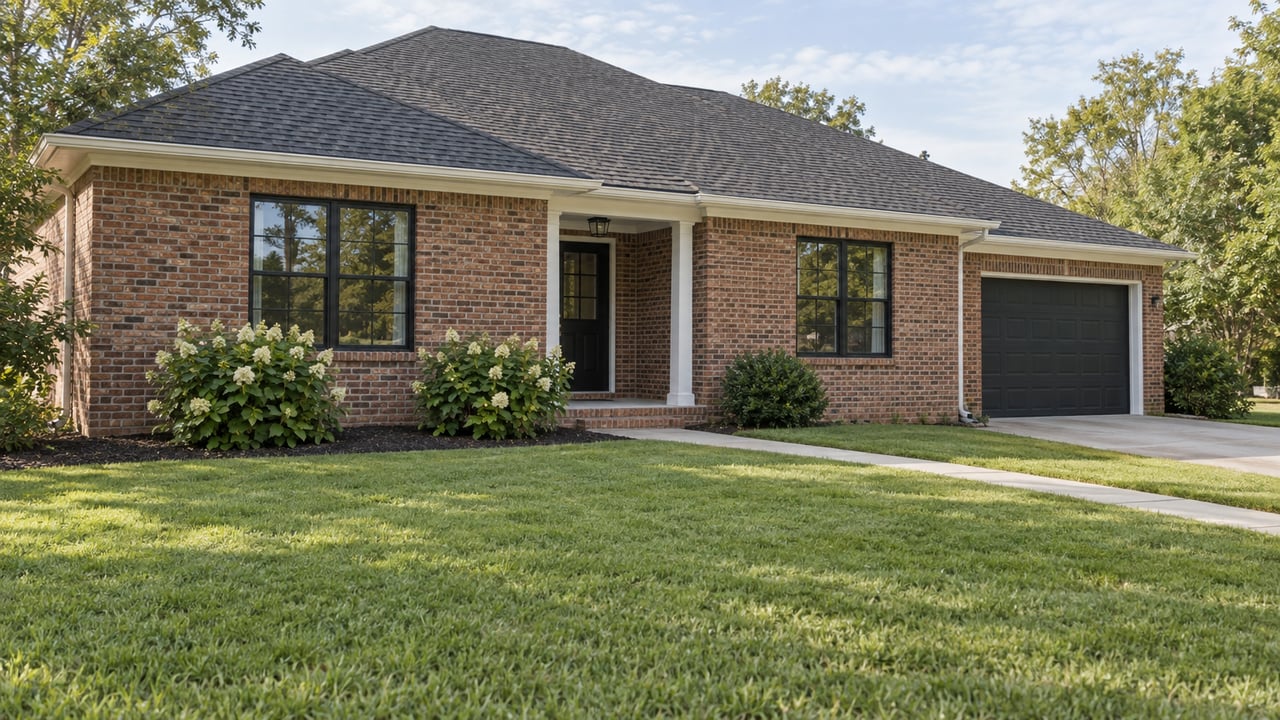
The most important part of D.R. Horton's current offer at Villages at Southbranch sits in the small print under the headline rate. The builder has "locked-in, through DHIM, a fixed interest rate for a pool of funds," and the rates are available "until pool of funds is depleted or rate expires." To get the rate, a buyer has to finance through DHI Mortgage, D.R. Horton's affiliated lender. The disclosure also says the rate "may require borrower to pay points."
That fine print explains a lot about how Olive Branch homes are selling this fall. The advertised rate is 4.99% on a fixed FHA loan and 5.50% on a fixed conventional loan, for buyers who contract on or after September 30, 2026 and close by November 30, 2026. Whether you're comparing a new build with a resale or listing an existing home, the number that matters right now is the monthly payment, and builders have tools for lowering it that a homeowner selling down the street doesn't.
The gap a resale listing is priced against
Here is what Olive Branch builders are advertising compared with the national averages from mid-October 2026.
| Source | 30-year fixed rate | As of |
|---|---|---|
| Freddie Mac PMMS national average | 7.40% | October 15, 2026 |
| MBA weekly survey, conforming loans | 7.50%, with 0.83 points | Week ending October 9, 2026 |
| D.R. Horton, Villages at Southbranch, FHA | 4.99%, 5.697% APR | Contract on or after 9/30/26, close by 11/30/26 |
| D.R. Horton, Villages at Southbranch, conventional | 5.50%, 5.972% APR | Same window |
| Grant & Co., The Orchard and Cypress Trails | 5.75% limited-time offer | Current listings |
The year-over-year change makes the gap bigger. A year ago, Freddie Mac's 30-year average was 6.27%. As of October 15, 2026, it's 7.40%, up more than a full percentage point. A buyer shopping for a regular loan today faces a higher rate than last fall, while the builder offers above come in below even last year's average.
The builder's own example shows what that looks like in dollars. D.R. Horton bases its FHA illustration on a $323,795 sales price and a $317,930 loan, with a total monthly payment of $2,400 that includes taxes, insurance, mortgage insurance and HOA dues. If a resale home at the same price is financed at the market rate, the buyer's payment is set by roughly 7.4%, not 5%.
Why a builder can do this and a resale seller can't fully match it
A builder that locks a pool of money through its own affiliated lender is paying for the rate across many homes. A homeowner selling one house has only one tool, which is offering a concession. Federal loan rules cap how much that concession can be, and they treat the seller and the builder the same way. The builder gets around the cap with a rate it arranged ahead of time through its own lender.
Here's how the caps work for a primary residence:
- Conventional loans. Fannie Mae's Selling Guide limits interested-party contributions to 3% when the loan-to-value ratio is above 90%, 6% between 75.01% and 90%, and 9% at 75% or below, based on the lower of the sales price or the appraised value. If a seller gives more than the cap, the excess is treated as a sales concession and comes off the price. Freddie Mac's guide uses the same 3%, 6% and 9% tiers.
- FHA loans. HUD Handbook 4000.1 lets sellers, builders and other interested parties contribute up to 6% of the sales price. Temporary and permanent rate buydowns count toward that 6%. HUD updated the handbook in August 2026, so check the current text on HUD's handbook page.
- VA loans. The VA limits seller concessions to no more than 4% of the home's reasonable value. Its temporary buydown page says seller- or builder-funded temporary buydowns count toward that 4%.
Take a buyer putting 5% down on a conventional loan, which puts the loan-to-value above 90%. On a $323,795 home, the seller is capped at 3% of the price, a little over $9,700, to cover the buyer's closing costs and any points. The CFPB explains that one discount point costs 1% of the loan amount. A 3% concession buys only a few points, and it may not stretch to closing costs too. That's why a resale seller often can't match a two-point rate gap with a concession alone.
Loan rules, concession limits and buydown terms depend on your lender, your loan program and your own situation. This post is general information, not legal or financial advice, so please confirm the details with your lender or another qualified professional before you rely on them.
The sticker price is moving too
Rate offers don't always mean prices stay firm. Grant & Co.'s community page lists Olive Branch starting prices of $484,950 at Cypress Trails, $490,000 at River Grove Estates and $515,000 at The Orchard. Its available-now listings come in under those starting prices:
- 9093 Apple Orchard Cove, The Orchard: $459,950 for 4 beds, 3 baths and 2,513 square feet, shown at about $2,590 a month
- 3394 Blooming Grove Road, The Orchard: $464,950 for 4 beds, 3 baths and 2,568 square feet, ready October 19, 2026
- 9842 Cypress Lodge Cove, Cypress Trails: $469,950 for 5 beds, 3.5 baths and 2,908 square feet
All three carry the 5.75% rate offer. That means a resale owner in the $450,000 to $500,000 range could be listed against a newer home, with a three-car garage, priced below its own community's advertised starting point and financed at a rate well under market. For that owner, the nearest competitor on a buyer's spreadsheet may be a new build in The Orchard rather than the resale two streets over.
The deals are on a clock, and the terms keep changing
These offers change quickly. In an August 12, 2026 post, Grant & Co. advertised a 5.25% fixed-rate buydown on more than 50 completed homes plus up to 3% in builder-paid closing costs. Its current listings show 5.75%. D.R. Horton's Villages at Southbranch page promotes a separate savings event that ends November 1, 2026. Its special rate requires closing by November 30, 2026.
The deadlines shape which homes qualify. A November 30 closing date favors homes that are already built. Villages at Southbranch listed 10 homes for sale, including 8248 Bankhead Dr marked "Special Interest Rate." Every completed home a builder carries into winter costs it money, so builders have every reason to sell this inventory before the year ends.
More homes are on the way. DeSoto County News reported that the Olive Branch Planning Commission was scheduled to consider the final plat for Center Hill Farms Phase 3 at its October 13 meeting. The plat covers 19 single-family lots and two common open spaces on about 6.67 acres.
What the county numbers say about room to negotiate
DeSoto County's listing data from September 2026 shows a market that's holding steady, not tightening. According to the St. Louis Fed's FRED database, the county's median listing price was $379,000, down 0.24% year over year. Active listings totaled 785, down 0.51% from a year earlier. The median home spent 62 days on the market, 5% faster than in September 2025.
These are asking prices and listing counts for the whole county, not closed sales in Olive Branch. Still, they help explain why builders are leaning on rates. Prices are flat and inventory is level, so a sticker-price cut doesn't make a home stand out the way it would in a falling market. A lower monthly payment does. For buyers, about two months of median market time means there's usually time to compare a builder's offer with a resale home carefully.
Questions to answer before comparing two homes
When you're weighing a builder-financed home against a resale home in Olive Branch, putting these answers side by side gives you a fair comparison:
- Is the rate tied to one lender? D.R. Horton's rate requires DHI Mortgage, though you aren't required to use DHIM to buy the home.
- Does the rate require points? Ask for the APR as well as the rate, and compare the total cash you'll need at closing.
- Is the buydown temporary or permanent? The CFPB explains that with a temporary buydown, payments usually go up each year until the buydown ends, typically after one to three years.
- Can you close by the deadline? An offer that expires November 30 helps only if the home and your loan are both ready by then.
- What would the resale seller offer instead? A price reduction, a concession within the caps above, or both can be compared to the builder's rate by looking at the total monthly payment.
A short FAQ
Can a resale seller in Olive Branch pay for a rate buydown? Yes, within the concession limits for the buyer's loan type. Under FHA rules, buydowns count toward the 6% cap. Under VA rules, seller-funded temporary buydowns count toward the 4% limit.
Are builder rates available on every new home? No. D.R. Horton's terms apply to "certain D.R. Horton homes in select communities," and the rate isn't available for every credit profile.
How should a resale price be judged against a builder offer? A resale price is best judged against the monthly payment a buyer could get on a comparable new home, not only against other resale homes.
If you're deciding between a new build and a resale home, or wondering how your home compares with the builder offers nearby, let's sit down and compare the actual monthly payments before you make a move. Heather L Williams and the My Home Realty team will help you figure out your real number in today's Olive Branch market. Let's Connect and Get Your Free Home Valuation.